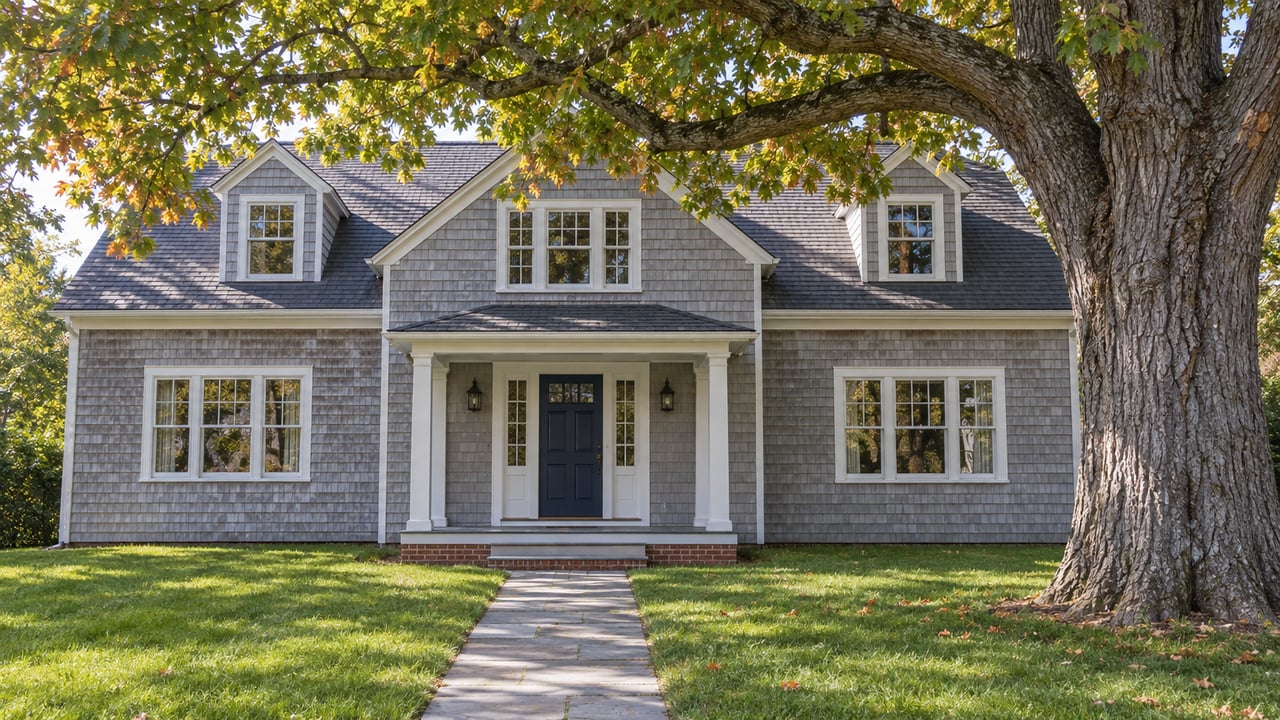
On a hillside inside Arnold Park, a white oak that has stood for roughly two hundred years carries a Maryland Big Tree Program score of 402 points, the highest recorded for a living white oak in the state. Most people who drive past the ball fields on Jones Station Road on their way to soccer practice or a Little League game have never walked up the hill to see it.
The tree is named for Wilmer Stone, a forester who once owned the land that became the park. It sits on public property now, open from sunrise to sunset, alongside baseball diamonds, a multipurpose field, tennis courts, a play area, and a concession stand. The tree itself asks for nothing more than a short walk off the path.
The math behind the number
Maryland has scored big trees the same way for a century. The formula, developed by Fred Besley, the state's first forester, and later adopted by tree programs nationwide, adds a tree's height in feet to its trunk circumference in inches, plus one quarter of its crown spread in feet. Run the numbers on the Wilmer Stone Oak and you land close to its official total:
- Height: 128 feet
- Trunk circumference: 253 inches, measured at chest height
- Crown spread: 83 feet
- One quarter of the crown spread: roughly 21
- Total: 128 + 253 + 21 = 402
That score outranks every other living white oak measured in Maryland. It would have ranked even higher, and possibly surpassed the 427-point National Champion white oak recorded in Virginia, if a storm in 1988 hadn't torn away part of the crown. What's left is a broken Y where the missing limb used to be, still visible if you look up from the base.
What it isn't
For sixty-one years, from 1941 until a thunderstorm brought it down in 2002, one specific white oak stood as the physical embodiment of Maryland's state tree designation. That was the Wye Oak, a roughly 460-year-old giant in Talbot County that measured 96 feet tall with a crown spread of 119 feet and a trunk circumference of 31 feet 10 inches, substantially greater in circumference than the Wilmer Stone Oak's.
The two trees make an odd pair on paper.
| Wye Oak (Talbot County) | Wilmer Stone Oak (Arnold Park) | |
|---|---|---|
| Era as the named state tree | 1941 to 2002 | Never formally designated |
| Age at last measurement | About 460 years | About 200 years |
| Height | 96 feet | 128 feet |
| Trunk circumference | 31 feet 10 inches | 253 inches (about 21 feet) |
| Crown spread | 119 feet | 83 feet |
| Current status | Fell in a June 2002 storm | Standing, with 1988 storm damage |
The Wye Oak was wider and older. The Wilmer Stone Oak is taller and, by the state's own scoring formula, currently holds the higher point total among living white oaks. Nobody has formally handed it the Wye Oak's old title. It just happens to be sitting in a neighborhood park in Arnold, outscoring every other living white oak the state has on record.
A nearby oak outside the contest
This year gives that fact new context. The Maryland Forest Service and the Maryland Forestry Foundation launched the Maryland 250 White Oak Contest on April 30, running from May 1 through December 31, 2026, timed to the nation's 250th anniversary. The rules are specific: only living white oaks over 13 feet in circumference qualify, and they have to be found on eligible State Forest land, which is a different category of public land than a state park or a county park. Cash prizes of up to $500 go to whoever locates the five largest qualifying specimens.
The Maryland Big Tree Program, which has kept a statewide register of champion and notable trees since 1925 and marked its own centennial in 2025, notes that only one white oak had previously been logged as a Big Tree within state forest lands before this year's contest opened. That scarcity is part of the point of the search.
Arnold Park is owned by Anne Arundel County, not the state, so its parkland is ineligible for the contest; the Wilmer Stone Oak, despite holding Maryland's highest score among living white oaks, cannot be entered.
The rest of the neighborhood's trees
Arnold's relationship with its tree canopy doesn't stop at one park. Chase Creek Woods, also within Arnold, was documented in a 2003 study for the Eastern Native Tree Society as one of the tallest privately held woodlands in the eastern United States, supporting nearly fifty native tree species and holding twelve individual state height records among them. It sits on land that has been farmed in some form since the early 1900s, a detail that says something about how much of Arnold's older tree cover survived the subdivisions built around it rather than getting cleared for them.
The B&A Trail runs close enough to Arnold Park to make a loop out of the visit, linking the park to Annapolis in one direction and Severna Park in the other for anyone who wants to turn a look at one tree into a longer ride.
Worth the walk this fall
White oak leaves turn a deep reddish color as the weather cools, which makes autumn a reasonable time to actually go find the tree rather than just drive past it again. The walk from the parking area up the hillside takes a few minutes. Nothing marks the spot with a sign built for tourists. It's a two-hundred-year-old tree in a public park that happens to outscore every other living white oak the state has measured, standing quietly through baseball season, tennis matches, and picnics without anyone treating it as the landmark its numbers say it is.
If you've walked past it a hundred times without knowing what you were looking at, this is the season to go back and actually look up. And if Arnold's back roads and hidden corners are the kind of local detail you want more of, Carol Gust keeps finding them.